



02 Oct Why Raised Access Flooring Matters in Modern Workspaces
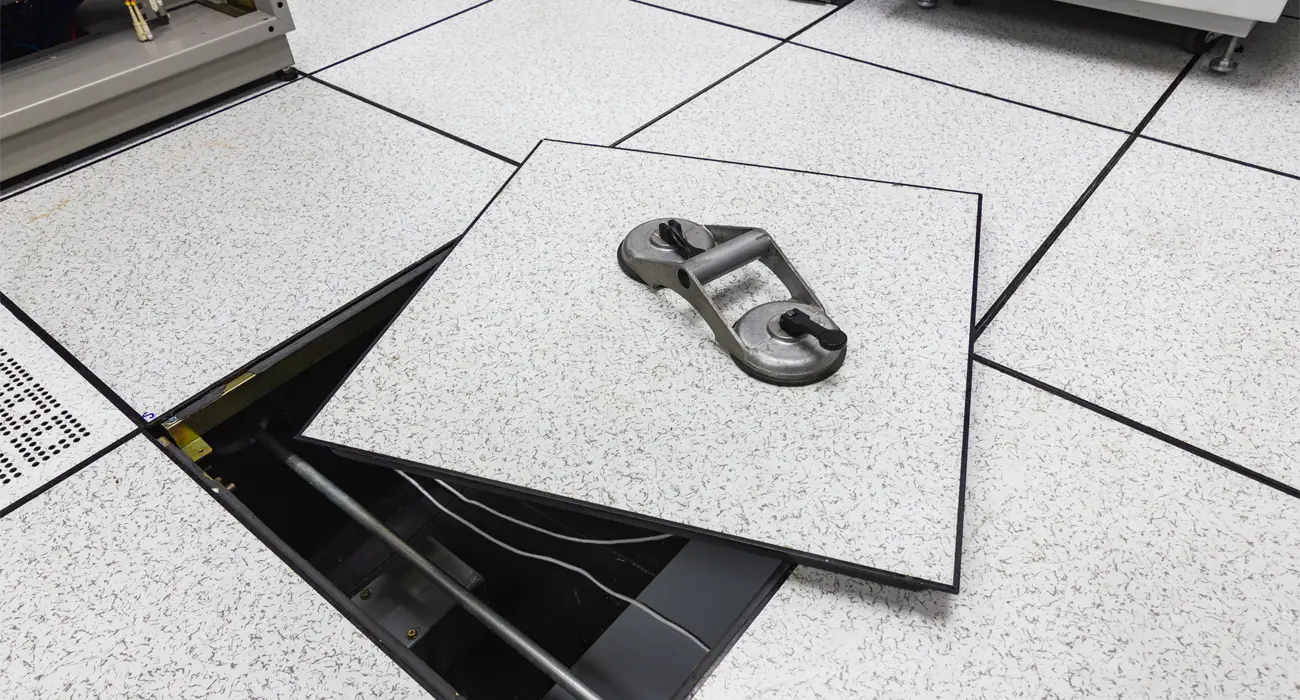
As modern workplaces continue to evolve, flexibility and future-readiness are no longer optional; they’re essential. Organizations today must support rapid technological change, hybrid work models, and shifting team structures, all while minimizing downtime and long-term costs. One of the most impactful yet often overlooked solutions enabling this adaptability is raised access flooring.More than just a flooring system, raised access flooring serves as a critical infrastructure layer that supports cabling, power, HVAC, and evolving spatial needs. When integrated thoughtfully, it becomes the foundation for truly agile, high-performing work environments.
The Changing Demands of Today’s Workspaces
Modern offices look very different from their predecessors. Open collaboration zones, private focus rooms, flexible meeting spaces, and technology-enabled workstations must coexist and change over time. Traditional slab-to-slab construction, with hardwired power and data embedded in walls and ceilings, makes these changes expensive and disruptive.Raised access flooring flips that model by placing infrastructure beneath a modular floor system, allowing workspaces to adapt as business needs shift. This approach aligns perfectly with organizations seeking long-term efficiency, scalability, and smarter use of space.
Seamless Cabling Access and Management
One of the most immediate benefits of raised access flooring is the ease of cabling access. Power, data, and communications lines are routed beneath removable floor panels rather than locked behind walls.This creates several advantages:
- Simplified installation and reconfiguration of technology
- Cleaner, more organized spaces without surface-mounted raceways or exposed cords
- Faster moves, adds, and changes (MACs) without demolition
As technology requirements increase, more devices, more bandwidth, more connectivity, raised access flooring ensures infrastructure can keep up without compromising aesthetics or functionality.
Flexible Power Distribution Where It’s Needed
In traditional offices, power outlets dictate where furniture and workstations can be placed. Raised access flooring reverses that limitation by allowing power distribution to move with the workspace.With modular power systems integrated beneath the floor:
- Workstations can be repositioned without rewiring.
- Collaboration zones can be added or removed easily.
- Power access points can be relocated to match evolving layouts.
This flexibility is especially valuable in hybrid offices, where space usage may change daily or seasonally. Raised access flooring ensures that power availability supports people—not the other way around.
HVAC Integration for Smarter Comfort
Raised access flooring also plays an increasingly important role in HVAC integration, particularly in underfloor air distribution (UFAD) systems. Instead of delivering air from overhead ductwork, conditioned air is supplied through the floor plenum and diffused upward into occupied spaces.Key benefits include:
- Improved thermal comfort by delivering air closer to occupants
- Greater individual control over airflow and temperature
- Enhanced energy efficiency, as UFAD systems often operate at higher supply air temperatures
This approach supports healthier, more comfortable work environments while aligning with sustainability and energy-performance goals.
Built-In Future-Readiness
Perhaps the greatest advantage of raised access flooring is its role in future-proofing workspaces. Business needs are rarely static; teams grow, technologies change, and workflows evolve. Raised access flooring provides a flexible backbone that accommodates these changes without requiring major renovations.Future-ready benefits include:
- Reduced long-term renovation costs
- Minimal disruption during upgrades or reconfigurations
- Support for new technologies as they emerge
By investing in adaptable infrastructure upfront, organizations avoid the cycle of costly tear-outs and rebuilds that plague traditional interiors.
Supporting Modular Design and Furniture Systems
Raised access flooring works best as part of a holistic modular interior strategy. When paired with movable walls, modular furniture, and flexible layouts, it enables truly dynamic environments.Together, these systems allow organizations to:
- Reconfigure spaces quickly for new teams or functions
- Balance collaboration and privacy without construction
- Maximize square footage utilization over time
The result is a workspace that evolves alongside the organization—supporting productivity, comfort, and long-term value.
A Strategic Investment, Not Just a Flooring Choice
While raised access flooring may appear to be a technical decision, its impact is strategic. It affects how easily a space can adapt, how efficiently technology is deployed, and how well the environment supports people at work.For organizations planning new builds or major renovations, raised access flooring is not just a design option—it’s a foundation for resilience, agility, and growth in an ever-changing business landscape.
Frequently Asked Questions
Q: What is raised access flooring?
A: Raised access flooring is a modular floor system elevated above the structural slab, creating a plenum for power, data, HVAC, and other building services.
Q: Is raised access flooring only for offices?
A: No. While commonly used in offices, it’s also ideal for data centers, training facilities, higher education, healthcare, and other environments that require flexibility and technology integration.
Q: Does raised access flooring limit design options?
A: Not at all. Modern systems offer a wide range of finishes and integrate seamlessly with modular walls and furniture, supporting both aesthetics and performance.
Q: Is it more expensive than traditional flooring?
A: Initial costs can be higher, but long-term savings from reduced renovations, faster reconfigurations, and improved energy efficiency often outweigh the upfront investment.
Q: Can raised access flooring support future technology upgrades?
A: Yes. Its modular nature makes it ideal for adapting to evolving power, data, and HVAC requirements.